
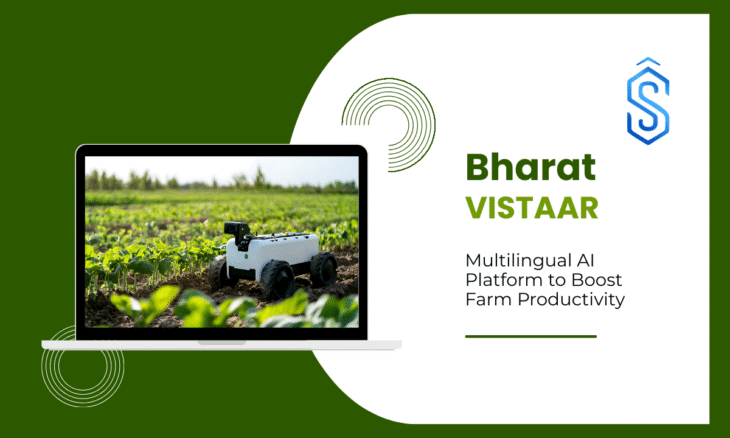
The Union Budget 2026–27 has proposed Bharat VISTAAR, a multilingual artificial intelligence platform aimed at enhancing farm productivity, improving farmer decision-making, and reducing agricultural risk through customised advisory support.
Presented in Parliament by Union Finance and Corporate Affairs Minister Nirmala Sitharaman, the Budget positions emerging technologies and artificial intelligence as key enablers in fulfilling national development priorities and strengthening citizen participation in India’s growth journey.
Bharat VISTAAR to Integrate AgriStack and ICAR Systems
Under the Budget proposal, Bharat VISTAAR – short for Virtually Integrated System to Access Agricultural Resources – will integrate AgriStack portals and the Indian Council of Agricultural Research (ICAR) package on agricultural practices with AI systems.
The platform is designed to deliver tailored advisory services to farmers, enabling informed decisions, higher productivity, and reduced exposure to risks.
Union Budget Emphasises AI and Emerging Technologies
The Union Budget 2026–27 highlights technology adoption as a tool for inclusive development, benefiting farmers, women in STEM, youth seeking upskilling opportunities, and Divyangjan.
Key government initiatives supporting new technologies include the AI Mission, National Quantum Mission, Anusandhan National Research Fund, and the Research, Development and Innovation Fund.
Also Read: Mega Textile Parks in Challenge Mode: Budget 2026 Announces Five-Component Textile Programme
On Bharat VISTAAR, Sridhar Muppidi, Co-Founder Ello.ai and [X] Cube Labs said, “We welcome the government’s move to set up a high-powered education-to-employment committee, especially its focus on the impact of AI on the services sector. Over the next 2–3 years, the services industry will see a fundamental shift, with individual productivity increasing 20–25x as AI becomes deeply embedded in daily work.
The way people interact with software and services will change completely – moving from screens and forms to natural voice-led interactions. Combined with India’s strong investments in linguistic AI, this creates a unique opportunity to make technology accessible, inclusive, and scalable across the country. Aligning education and skills with these real-world deployments will be critical to ensuring this transformation drives growth rather than disruption”.
Manish Agarwal, Co-Founder, KGeN: “The Union Budget 2026’s strong emphasis on AI – with 11 mentions, a 20-year tax holiday for data centres, and multilingual Bharat VISTAAR – positions India as a global AI leader. It bolsters scalable adoption in agriculture, governance, and more.
As an expert in sovereign models and datasets, I welcome the ongoing IndiaAI Mission support for indigenous foundational models and India-centric data ecosystems. To truly achieve ‘Make AI in India,’ we need faster access to diverse public datasets, deeper sovereign compute investments, and incentives for trusted Indian LLMs. This Budget accelerates progress – now double down on data sovereignty and homegrown innovation for ethical, inclusive AI leadership.”
Also Read: India’s Defence Budget Touches Record INR 7.85 Lakh Crore; Focus on Indigenous Manufacturing
Rajashri Sai, Founder & CEO, Impactree.ai, said, “The Union Budget 2026 sends a clear signal that India is ready to place technology, and particularly AI, at the heart of its next growth cycle. Over the next decade, we expect India’s IT and services sector to evolve from being largely execution-led to becoming insight- and outcome-driven, with AI, data platforms, and digital infrastructure shaping how value is created. This transition will not only redefine productivity but also open new categories of jobs and specialised skills across the ecosystem.
What will be critical is ensuring that emerging technologies are accessible beyond large enterprises. If implemented well, these missions have the potential to help MSMEs and mid-sized IT players participate meaningfully in global value chains, while positioning India as a trusted hub for next-generation digital services by 2047.”
Vinay Nair, Founder, KhetiBuddy said, “The launch of Bharat VISTAAR is a major step towards developing a common digital framework for the agricultural sector in India. By providing access to soil, weather, advisory, and scheme-related data in a federated manner, it will be possible to make better decisions at the farm level. The actual benefit will be realized when these platforms are integrated with other systems such as Verdant, which is used by food companies. By integrating farm-level intelligence with procurement, quality, and inventory management systems, it will be possible to eliminate inefficiencies and minimize resource waste. In the long run, this will enable more sustainable agricultural practices and enhance the resilience of the food value chain in India.”